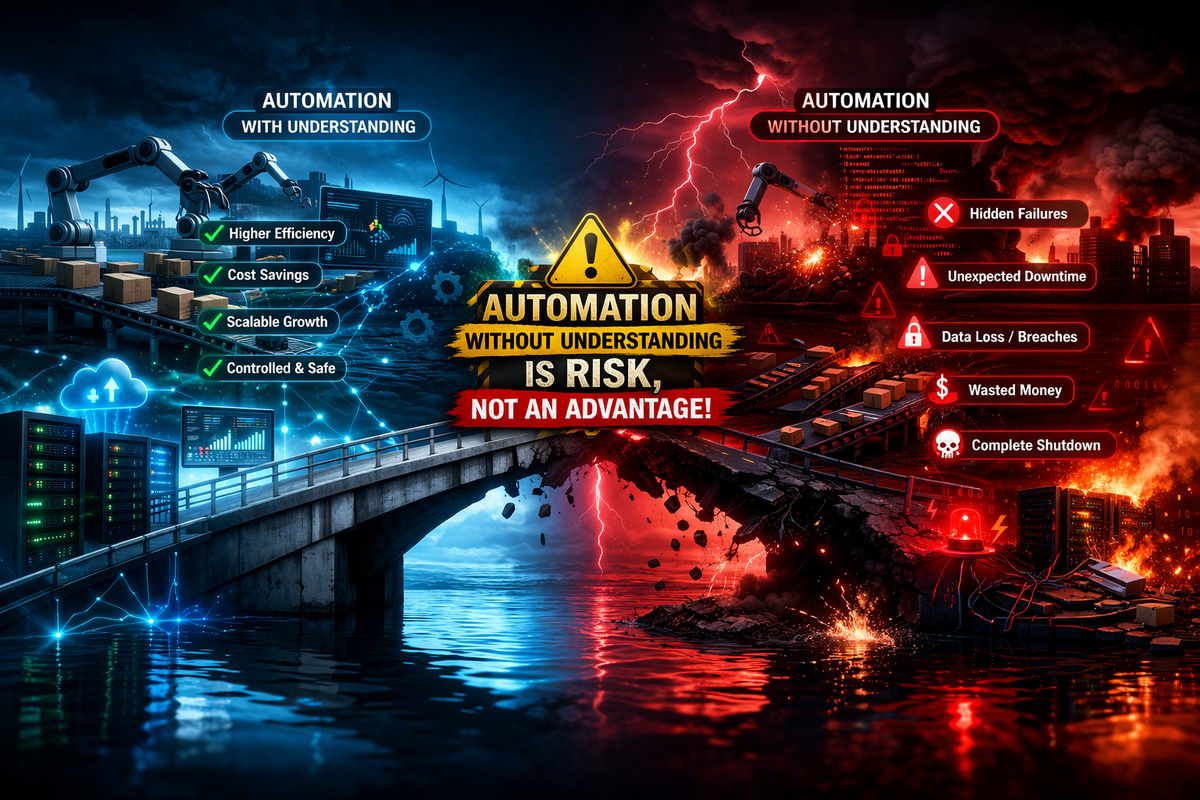
Automation Without Understanding Is a Risk, Not an Advantage
Automation promises speed and efficiency, but without proper understanding, it can introduce hidden risks. From unexpected failures to security vulnerabilities, blind automation often creates more problems than it solves.
Automation promises to free us from tedious work. But with every task we hand off to a machine, we quietly surrender a little piece of comprehension — and we rarely notice until it's gone.
There's a quiet pride in watching a script run. You wrote a few lines, you pressed a button, and now a computer is doing in seconds what used to take you an afternoon. The feeling is close to magic — and like all magic, it conceals something.
What it conceals is understanding. Every layer of automation you add between yourself and a process is also a layer of opacity. The more smoothly your systems run, the less you need to know how they work. And the less you need to know, the less you eventually do know.
This isn't a new observation. But it has become newly urgent.
How automation slowly hollows out expertise
Consider the spreadsheet. When finance teams moved from paper ledgers to Excel, they gained speed and scale. But they also lost something: the instinct that came from manually totalling a column, the feel for a number that seemed off before the formula could flag it. Today, many analysts can build elaborate models but cannot quickly sanity-check whether an output is plausible. The formula handles it. The formula might be wrong. They wouldn't necessarily know.
This is what researchers call skill fade the gradual erosion of a competency when it stops being exercised. Airline pilots who rely heavily on autopilot lose manual flying proficiency over time. Surgeons who use robotic systems report diminished open-surgery skills. Radiologists who lean on AI screening tools begin to miss the edge cases the AI wasn't trained on.
Automation doesn't eliminate the need for expertise. It just defers the moment when you discover you no longer have it.
The trap is that the automation works brilliantly, usually right up until it doesn't. And at the precise moment it fails, you need the expertise most. The competence you traded away for efficiency is the competence you need to handle the exception.
Every rung up is a rung away from reality
Software engineering offers a particularly clean illustration. Modern developers work at extraordinary heights of abstraction. You don't write memory management code; a garbage collector does it. You don't build networking primitives; a framework wraps them. You don't configure servers; a cloud provider provisions them with a command.
Each layer of abstraction is a genuine gift, it enables one person to build what once required a team. But it also means that when the abstraction leaks (and abstractions always eventually leak), the developer encounters machinery they've never had reason to study. The error message is from a layer they've never visited. The mental model they need doesn't exist yet.
Higher rungs on the abstraction ladder aren't inherently bad. But they should be climbed consciously, with an awareness of what you're choosing not to understand and not scrambled up in a rush because the tool made it easy.
When the tool writes the code you'd have written
All of this has intensified dramatically with the arrival of AI coding assistants, writing tools, and autonomous agents. The same dynamic automation creating distance from understanding is now happening faster, at more layers simultaneously, and with far less friction.
A developer using an AI assistant to write a sorting algorithm doesn't write the algorithm. They may not even read it carefully before accepting it. The code works. They move on. But they've also missed the moment the small, annoying, clarifying moment of having to think through the logic themselves. Multiplied across a hundred such moments a day, a year, a career, the cumulative loss of hard-won intuition is substantial.
The same is true beyond code. A manager who uses AI to draft all their communications gradually loses the habit of finding their own words. A student who uses AI to outline every essay loses the struggle the generative friction of trying to structure an argument from scratch. A designer who relies on AI-generated concepts loses the discipline of staring at a blank canvas until something emerges.
In each case, the AI is genuinely helpful. And in each case, something real is quietly given up.
It's not nostalgia. It's capability.
The concern here isn't romantic. It's not that manual processes are inherently virtuous, or that efficiency is suspicious, or that technology is corrupting some golden-age craftsmanship. The concern is strictly about capability about the things humans become unable to do, and the vulnerabilities this creates.
The ability to handle failure gracefully
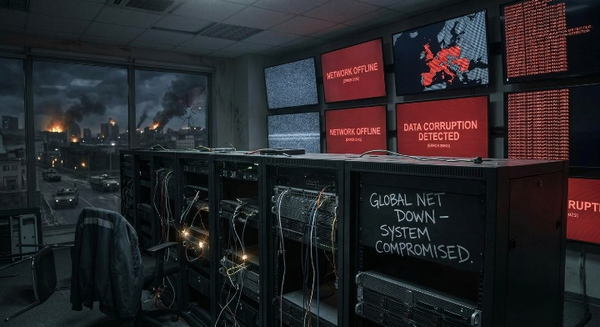
When automated systems break, the most critical skill is the ability to diagnose and recover without the automation. If that skill has atrophied, failures become crises. The hospital that can't operate without its electronic records system. The logistics network that freezes when the routing algorithm goes down. The engineer who can't debug the system because they've only ever seen it run.
The ability to catch errors before they compound
Deep familiarity with a domain generates intuition a sense that something is slightly off before you can articulate why. Automation, by removing the human from the repetitive work that builds that intuition, also removes the early-warning system. Errors that an experienced eye would have caught at step three now run undetected to step thirty.
The ability to ask the right questions
Perhaps most importantly: understanding a process deeply enough to know when to question its output. If you don't know how a thing works, you can't know when its result is suspicious. You become a consumer of outputs rather than an evaluator of them. And consumers of outputs, when those outputs are wrong, are the last to know.
The most dangerous relationship with a tool is one where you trust it completely because you understand it least.
Not less automation — but more intentional automation
None of this is an argument for Luddism. Automation is often the right choice for scale, for consistency, for freeing up cognitive bandwidth for higher-order problems. The issue is not whether to automate, but how to automate in ways that don't silently drain the understanding that makes the automation trustworthy in the first place.
The things that run themselves are the things we stop thinking about
There is a version of the future where automation is so comprehensive, so reliable, so seamless, that it genuinely doesn't matter that no individual human understands the whole system. Perhaps large, well-maintained, redundant automated systems can be trusted the way we trust the electrical grid, not understanding it, but reasonably confident it will keep working.
We are not in that future yet. We are in a transitional moment where automation is extensive enough to erode expertise, but not robust enough to replace it. The danger zone.
In this moment, the most important thing to protect is not efficiency. It is not speed. It is the capacity to understand, to look at a system, a process, an output, and know what it means, where it came from, and whether something has gone wrong.
Automate thoughtfully. But stay curious. Stay close to the work. The machine can run the process. Only you can understand it.
Anyone can automate a workflow.
Very few understand it well enough to automate it right.
That’s the difference we care about at HUMIVE