
Prescription Analysis: The Complete Guide to Safer, Smarter Medication Management in 2026
Prescription analysis is the frontline defense against medication errors — catching wrong drugs, dangerous interactions, and dosing mistakes before they reach patients. Here's the complete guide to how it works, why it matters, and how AI is transforming it in 2026.
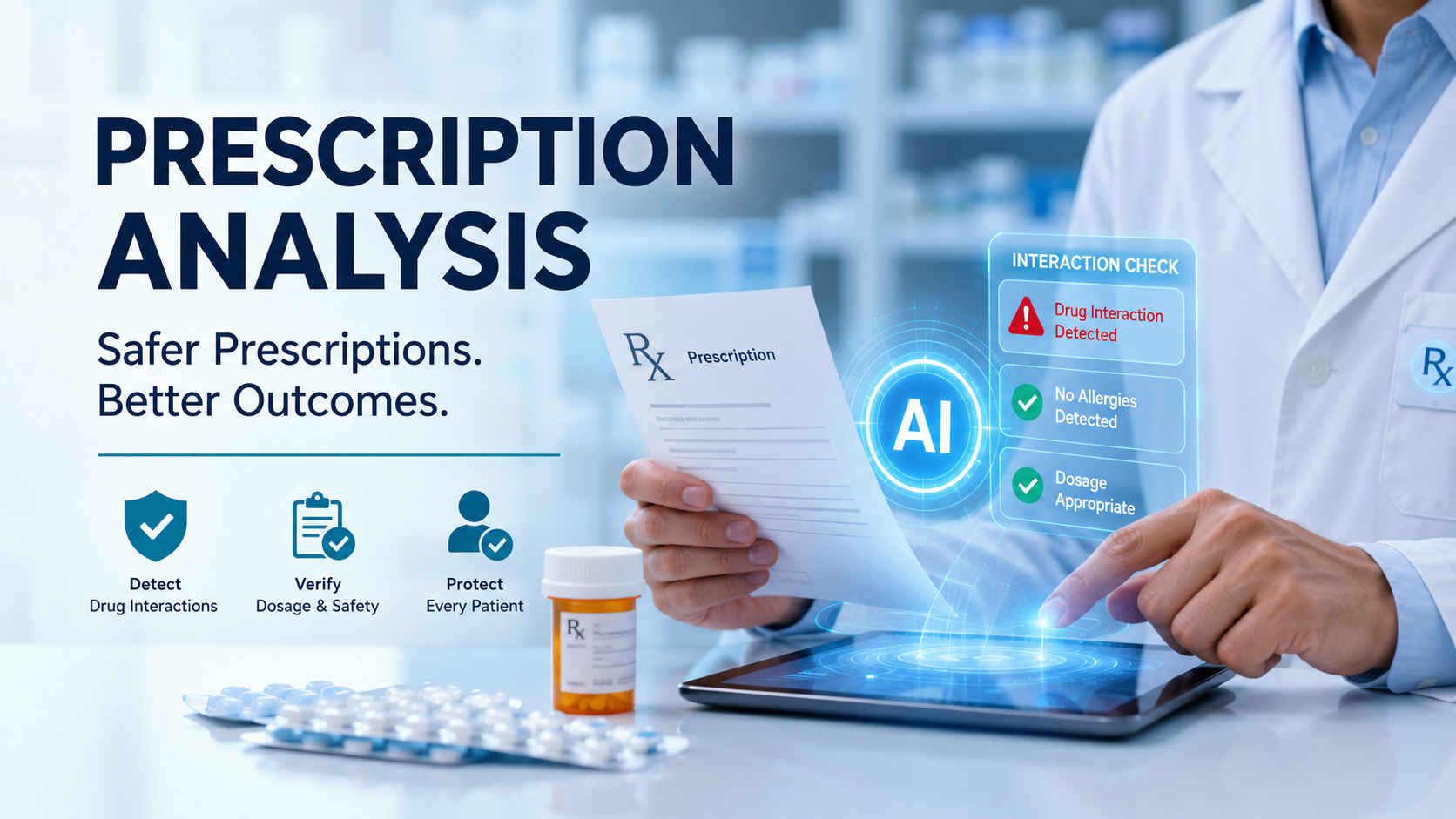
How modern prescription analysis is eliminating medication errors, catching dangerous drug interactions, and transforming patient outcomes — powered by AI.
What Is Prescription Analysis? (And Why It Matters More Than Ever)
Every single day, millions of prescriptions are written, dispensed, and consumed worldwide. But hidden within that everyday routine is a sobering reality: medication errors harm 1.5 million people in the United States alone every year, and between 7,000 to 9,000 patients die annually from prescription-related mistakes.
Prescription analysis is the systematic process of reviewing, evaluating, and verifying a prescription for its accuracy, safety, and clinical appropriateness — before a patient ever swallows a pill. It covers everything from checking the correct drug name and dosage to detecting potentially life-threatening drug-drug interactions, identifying contraindications, and ensuring the right medication reaches the right patient.
What once depended entirely on the trained eye of a clinical pharmacist is now being supercharged by artificial intelligence, machine learning, and automated decision-support systems — reshaping the entire landscape of pharmaceutical care.
Whether you're a healthcare professional, a patient, a pharmacy student, or simply someone who wants to understand what happens after a doctor hands you a prescription — this guide covers everything you need to know.
The Core Components of Prescription Analysis
Prescription analysis isn't a single action — it's a multi-layered clinical process. Here's what a complete prescription review covers:
1. Prescription Legibility & Completeness Check
Before any clinical evaluation begins, the prescription itself must be readable and complete. This sounds basic, but illegible handwritten prescriptions remain one of the leading causes of dispensing errors globally. A complete prescription must contain:
- Patient's full name, age, and weight (where applicable)
- Date of prescription
- Drug name (generic or brand), strength, and dosage form
- Dose, frequency, and duration of therapy
- Prescriber's name, designation, and signature
- Registration number and contact information
What happens when a prescription is incomplete?
When any of these elements are missing or unclear, the pharmacist must contact the prescribing physician before dispensing. An incomplete or ambiguous prescription is treated as an unverified one — dispensing it without clarification is a legal and clinical risk.
2. Drug-Drug Interaction (DDI) Screening
This is one of the most critical — and complex — aspects of prescription analysis. A drug-drug interaction occurs when one medication alters the way another works in the body, either increasing its toxicity or reducing its effectiveness.
Studies show that in prescriptions written for patients with multiple chronic conditions like diabetes, cardiac disease, or hypertension, up to 70% contain at least one potential drug-drug interaction. Of those, approximately 20% are classified as severe.
The three main types of drug interactions screened during prescription analysis:
- Drug–Drug Interactions (DDI): One medication interferes with another (the most common type)
- Drug–Food Interactions: Certain foods (like grapefruit juice) alter drug metabolism
- Drug–Disease Interactions: A medication worsens an existing health condition
Modern prescription analysis tools like Medscape Drug Interaction Checker, Micromedex, and AI-powered clinical decision support systems flag these interactions in real time — giving pharmacists and physicians the data they need to intervene before harm occurs.
3. Dose Verification & Appropriateness
Even the right drug can become dangerous at the wrong dose. Dose verification checks whether:
- The prescribed dose falls within the safe therapeutic range for the patient
- The frequency of administration is clinically appropriate
- Dosing is adjusted for special populations (elderly patients, children, patients with renal or hepatic impairment)
- The duration of therapy is clinically justified
Leading dosing errors — wrong dose followed by omission errors and wrong drug type — are the most frequent medication errors at the ordering and prescribing stages.
4. Therapeutic Duplication Detection
Therapeutic duplication occurs when a patient is prescribed two or more drugs from the same class that serve the same purpose — essentially doubling the intended effect and increasing adverse risk. Prescription analysis identifies these redundancies and flags them for prescriber review.
5. Contraindication & Allergy Screening
Every prescription is cross-referenced against the patient's known allergy profile and existing diagnoses. A prescription for a penicillin-based antibiotic for a patient with a documented penicillin allergy, for example, would be immediately flagged and rejected during this stage.
Types of Prescription Analysis
Prescription analysis exists at multiple points in the medication management lifecycle:
Prospective Prescription Analysis
This happens before a medication is dispensed. The pharmacist or clinical decision support system reviews the prescription proactively to catch errors before they reach the patient. This is the most impactful form of prescription analysis — it stops errors at the source.
Concurrent Prescription Analysis
This occurs during the medication administration process — common in hospital settings where nurses and automated dispensing cabinets cross-check prescriptions in real time as they prepare medications for patients.
Retrospective Prescription Analysis
This is a review that happens after medications have been dispensed or administered. It's used for audit purposes, pharmacovigilance, drug utilization review, and quality improvement programs. While it can't prevent the immediate error, it helps identify patterns that improve systems and protocols going forward.
How AI Is Revolutionizing Prescription Analysis in 2026
The entry of artificial intelligence into pharmacy practice has transformed prescription analysis from a manual, time-intensive task into a fast, data-rich, highly accurate process.
Machine Learning for Error Prediction
Contextual language models trained on millions of electronic health records can now detect invalid or erroneous prescriptions by verifying that a prescribed medication is appropriate given the full clinical context of the patient — with accuracy rates reaching 96.63% in validated research models.
AI-Powered Clinical Decision Support Systems
Platforms like MedAware use patient-specific clinical data to identify outlier prescriptions — catching errors that even experienced pharmacists might miss because they fall outside statistically normal patterns for a given patient profile.
Robotic Dispensing & Automated Verification
Major pharmacy chains have deployed robotics and AI at scale. CVS uses centralized AI and robotics across more than 9,000 stores. Walgreens has centralized robotic hubs that now fill 60% of prescriptions for approximately 3,000 stores. Walmart processes up to 100,000 prescriptions daily through automation — with plans to support 90% of stores with this technology.
The results are measurable: hospital implementations of AI-driven prescription analysis have reduced prescription distribution errors by up to 75% and enhanced the detection of adverse medication reactions by up to 65%.
Natural Language Processing (NLP) for Handwritten Prescriptions
Despite the push toward e-prescriptions, handwritten prescriptions remain prevalent in many markets — particularly in developing countries. NLP-powered OCR (Optical Character Recognition) tools now read, interpret, and flag handwritten prescriptions for legibility and accuracy issues, converting them into structured digital data for downstream analysis.
The Role of the Clinical Pharmacist in Modern Prescription Analysis
Despite rapid automation, the clinical pharmacist remains irreplaceable in the prescription analysis workflow. AI handles the volume, pattern recognition, and speed — but the pharmacist brings clinical judgment, patient communication, and nuanced decision-making to every complex case.
In fact, AI is expanding the pharmacist's role rather than shrinking it. By automating routine dispensing tasks, intelligent systems free pharmacists to redirect their expertise toward:
- Patient counselling and medication education
- Comprehensive medication reviews for complex patients
- Identifying and managing adverse drug reactions
- Medication reconciliation during hospital admissions and discharges
- Collaborative prescribing in chronic disease management
The Royal Pharmaceutical Society published its formal policy on AI in pharmacy in 2025, expressing strong support for the responsible and effective integration of AI — while emphasizing that clinical oversight must remain with qualified pharmacists.
Prescription Analysis in Special Populations
Prescription analysis becomes especially critical — and complex — in vulnerable patient groups:
Elderly Patients (Geriatric Pharmacology)
Older adults are disproportionately affected by medication errors. They typically take multiple medications (polypharmacy), have reduced kidney and liver function that affects drug metabolism, and are at higher risk for adverse drug reactions and fall-inducing side effects. Tools like the Beers Criteria and STOPP/START criteria provide frameworks specifically designed for prescription analysis in this population.
Paediatric Patients
Dosing for children is not simply a scaled-down version of adult dosing — it requires weight-based calculations, age-appropriate formulations, and knowledge of developmental pharmacology. Prescription analysis in paediatrics demands an additional layer of precision.
Patients with Renal or Hepatic Impairment
The kidneys and liver are the primary organs responsible for drug clearance. Patients with reduced function in either organ require carefully adjusted doses — something that must be explicitly reviewed during prescription analysis to prevent drug accumulation and toxicity.
Pregnant and Breastfeeding Women
Every prescription for a pregnant or breastfeeding patient must be evaluated for fetal or neonatal safety. This is a highly specialized area of prescription analysis governed by pregnancy drug classification systems and evidence-based guidelines.
Drug Utilization Review (DUR): The Population-Level Prescription Analysis
While individual prescription analysis focuses on the single patient, Drug Utilization Review (DUR) zooms out to analyze prescription patterns across large populations.
DUR programs — both prospective and retrospective — are used by:
- Health insurance payers to identify overuse, underuse, and misuse of medications
- Government health agencies to monitor antibiotic resistance and controlled substance prescribing trends
- Hospitals and health systems to benchmark prescribing quality against clinical guidelines
- Pharmaceutical companies for post-market surveillance and pharmacovigilance
DUR is the macro-scale version of prescription analysis, and it's increasingly powered by big data analytics platforms that process millions of prescription records simultaneously to detect population-level signals — such as a spike in opioid prescribing in a specific geographic region, or the unexpected increase in a particular drug-drug interaction combination.
Common Prescription Errors Caught by Analysis
Here are the most frequently detected errors during prescription analysis:
Prescribing Errors:
- Wrong drug selection
- Incorrect dose or dose unit
- Wrong frequency (e.g., "once daily" vs. "twice daily")
- Missing indication
- Drug prescribed despite known allergy
Transcription Errors:
- Illegible handwriting misread by the dispenser
- Decimal point errors (e.g., 1.0 mg misread as 10 mg)
- Ambiguous abbreviations (e.g., "μg" mistaken for "mg")
Dispensing Errors:
- Wrong drug dispensed (sound-alike/look-alike drugs)
- Wrong strength dispensed
- Wrong patient receives the medication
Monitoring Errors:
- Failure to check required lab values before dispensing (e.g., INR for warfarin patients)
- No follow-up prescribed for high-risk medications
A clinically meaningful prescribing error occurs when, as a result of a prescribing decision or prescription writing process, there is an unintentional reduction in the probability of treatment being timely and effective — or an increase in the risk of harm."— International Consensus Definition of Prescribing Error
Tools & Technologies Used in Prescription Analysis
The modern prescription analysis toolkit includes:
Clinical Reference Databases:
- UpToDate
- British National Formulary (BNF)
- Micromedex
- Medscape Drug Interaction Checker
- Lexicomp
Pharmacy Management Systems:
- Epic (with integrated clinical decision support)
- AthenaHealth
- Cerner / Oracle Health
AI-Powered Prescription Analysis Platforms:
- MedAware (outlier detection)
- Sully.ai AI Pharmacist (automated medication verification)
- Pharmie AI / Asepha.ai (workflow automation)
Regulatory Frameworks:
- WHO Essential Medicines List
- American Diabetes Association (ADA) Guidelines
- KDIGO Guidelines (Nephrology)
- NICE Guidelines (UK)
- IDSA Guidelines (Infectious Disease)
The Future of Prescription Analysis: What's Coming Next
The prescription analysis landscape is evolving rapidly. Here's what the next five years look like:
Predictive Prescribing Analytics: AI systems that don't just analyze existing prescriptions but predict which patients are at highest risk of medication errors — before the prescription is even written.
Real-Time EHR Integration: Prescription analysis tools fully embedded within clinical workflows, so physicians receive safety alerts at the point of prescribing — not after.
Blockchain for Prescription Integrity: Immutable digital records that prevent prescription fraud, tampering, and duplication — particularly relevant for controlled substances.
Pharmacogenomics-Informed Analysis: Prescriptions analyzed not just against clinical guidelines but against the patient's own genetic profile — understanding how their unique genes affect drug metabolism and response.
Global Expansion of AI Pharmacy: The global AI in pharma market is projected to grow from $1.94 billion in 2025 to $16.49 billion by 2034. Compliance automation and clinical workflow optimization are the primary growth drivers
Final Thoughts: Prescription Analysis Is Patient Safety
At its core, prescription analysis is not a bureaucratic checkbox. It is one of the most consequential acts in healthcare — a trained professional or intelligent system standing between a patient and a potentially life-altering error.
As healthcare grows more complex — with aging populations, polypharmacy, growing antibiotic resistance, and increasingly sophisticated treatments — the role of prescription analysis will only become more critical.
The good news: the tools available in 2025 are more powerful than ever. AI, machine learning, robotic dispensing, and integrated clinical decision support are turning what was once a fallible human process into a precise, scalable, and measurable safety system.
But technology works best alongside clinical expertise — not instead of it. The future of prescription analysis is human intelligence, amplified.