Safety Reporting & Incident Analysis: Why Most Organizations Are Still Flying Blind — And How AI Is Finally Turning the Lights On
Most organizations collect safety data but fail to use it effectively. This blog explores how AI-powered incident analysis transforms raw reports into predictive insights, helping teams identify risks early and prevent accidents before they happen.
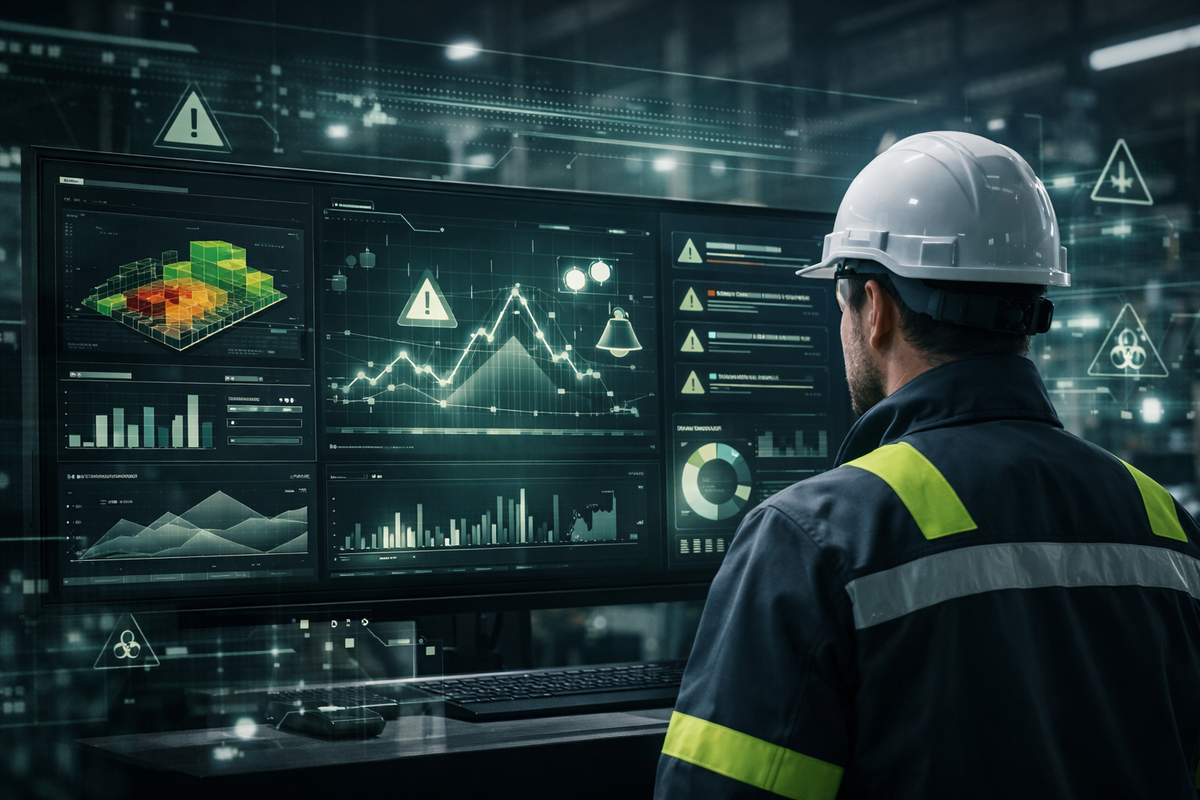
Every major industrial disaster in history had warning signs. They were documented, filed, and forgotten. The problem was never a lack of data — it was a lack of intelligence applied to that data in time to matter.
The Broken State of Traditional Safety Reporting
Walk into most organizations today and you'll find safety reporting that looks remarkably similar to what it did twenty years ago. Paper forms. Digital forms that are essentially paper forms on a screen. Incident logs buried in spreadsheets. Near-miss reports that nobody reads until after something goes wrong.
The fundamental flaw in traditional safety reporting isn't effort — safety officers work hard. The flaw is structural. Systems built to record incidents are not built to analyze them. Recording and analyzing are two entirely different disciplines, and most organizations have invested heavily in the first while almost entirely neglecting the second.
The result? Data graveyards. Thousands of incident reports that collectively contain the pattern that would have prevented the next accident — but no mechanism to surface it.
What "Incident Analysis" Actually Means vs. What Most Teams Think It Means
There's a widespread confusion in safety culture between incident investigation and incident analysis — and conflating them is costing lives and money.
Incident investigation is reactive. Something happened. You find out what happened, who was involved, what failed, and you close the report. It's forensic. It looks backward at a single event.
Incident analysis is systemic. It looks across all events — incidents, near-misses, unsafe conditions, first-aid cases — and asks: what patterns exist? Where are clusters forming? What leading indicators are being missed? It looks forward, and it works at scale.
Most organizations are excellent at investigation and poor at analysis. The shift from one to the other is the single most important upgrade a safety program can make.
The Hidden Cost of Under-Reported Near-Misses
For every serious workplace injury, research based on Heinrich's Triangle and its modern updates suggests there are hundreds of near-misses and unsafe conditions that preceded it. Near-misses are gold. They are free lessons — incidents where the system almost failed but didn't, giving organizations the chance to fix the root cause before someone gets hurt.
Yet near-miss reporting remains chronically underutilized because of a deeply human problem: fear and friction.
Fear — workers worry that reporting a near-miss will reflect poorly on them, invite scrutiny, or result in blame. Friction — reporting systems are cumbersome, time-consuming, and feel like paperwork that disappears into a void.
The consequence is an invisible iceberg. The visible tip is the recordable injuries. The enormous mass beneath the surface — near-misses, unsafe acts, unsafe conditions — goes largely unreported and entirely unanalyzed.
How AI Is Transforming Safety Reporting at the Input Stage
The first place AI is making a measurable difference is at the point of reporting itself — making it faster, smarter, and less intimidating.
Voice-to-Report Technology — Workers can now verbally describe an incident on a mobile device. AI transcribes, structures, and categorizes the report automatically, reducing the time to file from 20 minutes to under 3. Lower friction means higher reporting rates.
Smart Forms with Dynamic Fields — Instead of static forms, AI-driven reporting interfaces ask follow-up questions based on what's being reported. A slip-and-fall triggers questions about lighting, footwear, and surface conditions. A chemical exposure triggers questions about PPE and ventilation. The form thinks with the reporter.
Sentiment and Language Analysis — AI can now detect hesitation, vagueness, or minimizing language in reports — flags that suggest a reporter may not be sharing the full picture, prompting a follow-up rather than letting an incomplete report get filed and forgotten.
Anonymous Reporting with AI Triage — AI-powered anonymous channels allow workers to report concerns without fear, with the AI triaging severity and urgency so that critical reports surface immediately rather than sitting in a queue.
The Analysis Layer: Where AI Earns Its Place in Safety
Collecting better reports is valuable. But the real transformation happens in what AI does with those reports once they exist.
Where Humive Fits In
At Humive, we help organizations bridge this exact gap between data collection and actionable intelligence. By combining AI-powered pattern recognition, automated root cause analysis, and real-time risk scoring, we enable safety teams to move from reactive reporting to proactive prevention. Instead of waiting for patterns to emerge manually, Humive surfaces critical insights instantly — helping teams identify high-risk areas, prioritize interventions, and prevent incidents before they happen.
Pattern Recognition Across Large Datasets — AI can process thousands of incident reports simultaneously, identifying clusters by location, time of day, shift, equipment type, or task category that no human analyst would find manually. A pattern of hand injuries on the night shift in one specific bay? AI finds it in minutes. Traditional analysis might find it in months — or after another injury.
Root Cause Analysis at Scale — Modern AI tools apply root cause frameworks — 5 Whys, Fault Tree Analysis, Bow-Tie models — automatically, suggesting probable contributing factors based on historical incident data and the specifics of the current report. This doesn't replace human judgment; it accelerates and structures it.
Predictive Risk Scoring — By correlating leading indicators (near-misses, unsafe conditions, behavioral observations) with lagging outcomes (recordable injuries, lost-time incidents), AI builds predictive models that score areas, teams, or processes by risk level in real time. Organizations can intervene before the incident — not after.
Cross-Facility Benchmarking — For multi-site organizations, AI analysis can compare safety performance across locations, identify which sites are improving and why, and transfer best practices with precision rather than guesswork.
Building a Reporting Culture That AI Can Actually Work With
AI analysis is only as good as the data it receives. A technically sophisticated system fed incomplete, biased, or fear-driven reports will produce sophisticated but wrong insights. Technology and culture must evolve together.
The organizations seeing the greatest results from AI-powered safety systems have invested equally in both dimensions:
Psychological Safety First — Workers must genuinely believe that reporting incidents and near-misses will not result in punishment. This requires visible leadership behavior, not just policy documents. When a supervisor reports their own near-miss publicly and nothing bad happens, that changes the reporting culture faster than any training program.
Closing the Loop Visibly — One of the biggest reasons near-miss reporting stays low is that reporters never see anything change. AI systems that automatically generate corrective action workflows — and notify reporters when actions are completed — turn reporting from a one-way street into a feedback loop. People report more when they see it matters.
Training People to Interpret AI Outputs — Safety officers and managers need to be able to read and act on AI-generated risk scores and pattern reports. Data literacy in safety roles is no longer optional; it's a core competency.
The Regulatory Dimension: Compliance as a Floor, Not a Ceiling
Regulatory compliance — OSHA, ISO 45001, local safety legislation — sets the minimum. Organizations that treat compliance as the goal of their safety reporting system are building a floor and calling it a ceiling.
AI-powered safety systems help with compliance as a byproduct of doing something more ambitious: genuinely preventing harm. Automated report generation, audit trail maintenance, and regulatory submission formatting are tasks AI handles efficiently — freeing safety professionals to focus on analysis and prevention rather than paperwork.
The organizations that win on safety — lower incident rates, lower insurance costs, higher workforce trust — are the ones that use compliance reporting as a data source for intelligence, not just as a box to check.
What Incident Analysis Looks Like in 2026 and Beyond
The near-term future of safety reporting and incident analysis has several clear directions:
Real-Time Environmental Monitoring Integration — Wearables, IoT sensors, and environmental monitors feeding directly into safety platforms, triggering automatic incident reports when threshold conditions are breached — before a human even notices something is wrong.
Natural Language Querying of Safety Data — Safety managers asking their system in plain language: "What are our top three risk areas this quarter?" and getting an analyzed, visualized answer in seconds rather than pulling reports manually.
Predictive Maintenance Linked to Safety Outcomes — Connecting equipment maintenance data with incident data to predict not just when a machine will fail, but when that failure is likely to cause injury.
AI-Assisted RCA Interviews — Structured incident investigation interviews guided by AI, ensuring consistency, reducing interviewer bias, and flagging when important lines of inquiry are being missed.
The Bottom Line
Safety reporting has always been about one thing: preventing the next incident. For decades, the gap between what was reported and what was learned remained wide — filled with good intentions and inadequate tools.
AI doesn't close that gap automatically. It closes that gap when organizations commit to building cultures where truth flows freely, data is treated as intelligence rather than paperwork, and prevention is valued over blame.
The technology is ready. The question is whether the organizations using it are ready to let it show them what they've been missing.
Because the warning signs are almost, always and already in the data. They always were.
Contact with us to prevent your further incident :- humive.com