The Future of Sports Training and Performance: How Data, AI, and Smart Systems Are Transforming Athletic Development
The gap between good and great is decided in the data. Explore how AI, player assessments, game metrics, and smart dashboards are transforming sports training — and how Humive helps clubs develop better athletes.
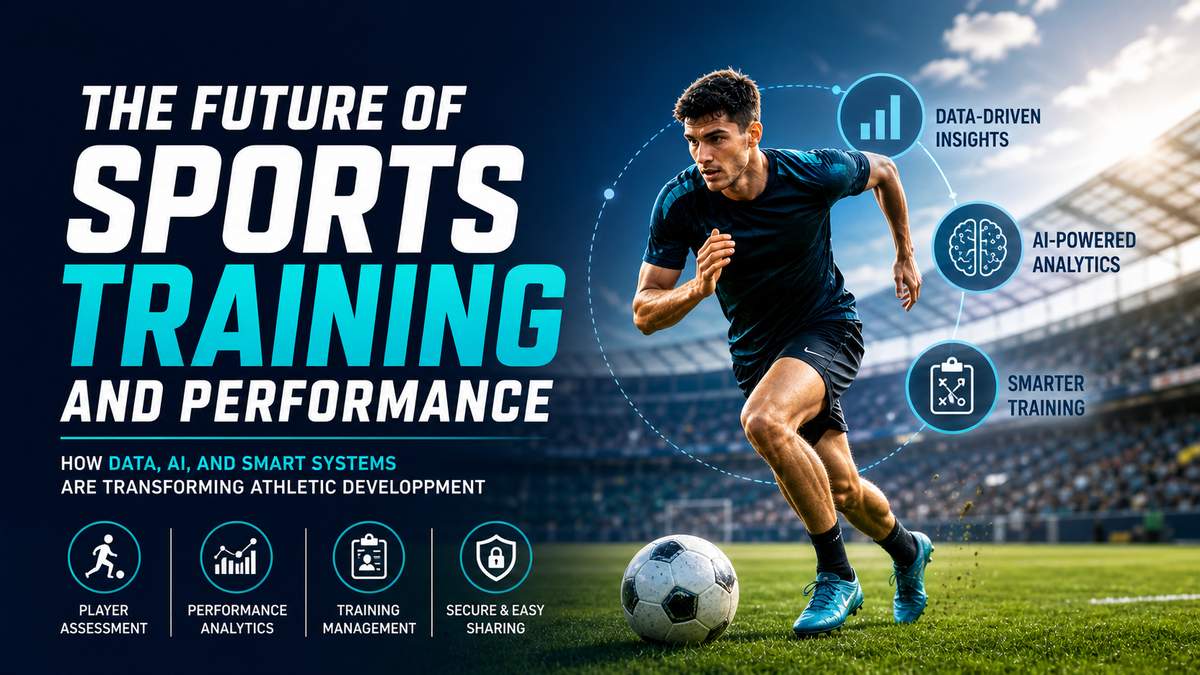
📊 The gap between good and great is no longer decided purely on the training ground — it is decided in the data.
The world of sports has never been more competitive. Whether you are a young athlete dreaming of a professional career, a coach managing a squad of twenty players, or a club director overseeing an entire organization's development pipeline, one truth remains constant: the gap between good and great is no longer decided purely on the training ground. Today, it is decided in the data.
Sports training and performance management has undergone a dramatic revolution over the past decade. What was once a domain of instincts, paper notebooks, and post-match gut feelings has transformed into a science-backed, technology-driven ecosystem where every sprint, every pass, every tactical decision, and every psychological trait can be measured, analyzed, and improved. Organizations that embrace this transformation are not just staying competitive — they are redefining what athletic excellence looks like.
This blog explores the key pillars of modern sports training and performance — from player assessment frameworks and training management systems to AI-powered analytics and the critical human elements that technology can never replace.
1. Moving Beyond the Eye Test: The Rise of Multi-Dimensional Player Assessment
For generations, player evaluation in sports came down to the "eye test" — what a coach saw in practice or on match day. While experienced observation remains invaluable, it is inherently limited. A coach cannot watch twelve players simultaneously. Fatigue, bias, and limited sample sizes all distort perception.
Modern performance platforms replace subjective guesswork with structured, repeatable assessment frameworks. A comprehensive evaluation now spans four critical dimensions:
- Technical Skills — dribbling accuracy, passing range, shooting precision, and defensive positioning. These are the core craft elements of any sport.
- Tactical Intelligence — the ability to read the game, make decisions under pressure, and position correctly. Technical ability without tactical application rarely translates to the highest levels.
- Physical Fitness — speed, stamina, and strength data that establish baselines and track progress across seasons. Physical metrics are often the earliest indicators of overtraining, injury risk, or developmental plateaus.
- Psychosocial Attributes — teamwork, attitude, focus, motivation, resilience, confidence, and discipline. Research consistently shows that elite athletes are distinguished from near-elite athletes more often by psychological traits than physical ones.
🎯 When all four dimensions are tracked over time, coaches gain a complete picture of each athlete — not just a snapshot of today's performance, but a developmental trajectory that informs smarter training decisions.
2. Training Management: From Session Logs to Performance Intelligence
A training session is only as valuable as the insight it generates. Traditional training logs captured attendance and perhaps a rough description of drills completed. Modern training management systems go far deeper.
Effective platforms allow coaches to design sessions with categorized objectives, assign them to individual players or entire squads, and track granular sub-metrics for each participant. Training categories — technical drills, tactical workshops, set-piece rehearsals, or conditioning blocks — are logged against individual player records, creating an auditable history of development.
The ability to import and export training data in standard formats like Excel adds another layer of flexibility, allowing coaching staff to collaborate across departments, share records with analysts, and maintain clean historical archives.
"Over time, training data enables visualization of performance trends that answer questions coaches have long struggled to answer quantitatively: Is this player's stamina improving? How has their passing accuracy evolved over six months? Which training categories correlate with improved game-day output?"
Player-specific training histories support individualized development plans. Instead of applying a one-size-fits-all program to an entire squad, coaches can tailor sessions to the specific technical deficits and physical profiles of each athlete — a practice long standard in elite sport but now becoming accessible at every level of competition.
3. Game Metrics: Capturing What Happens When It Matters Most
Training performance predicts game performance — but the two are not identical. High-pressure match environments surface capabilities and weaknesses that never appear in practice. This is why robust game metric capture is essential to any complete performance management system.
Modern platforms go far beyond goals and assists. A comprehensive game metrics framework captures:
- Passing statistics — completed passes, failed passes, and overall pass success percentage
- Dribbling statistics — successful dribbles, failed attempts, and efficiency ratios
- Tackle statistics — tackles won, tackles lost, and success rate
- Shot statistics — total shots, shots on target, and conversion percentages
- Distribution and accuracy metrics — capturing how players move the ball under pressure
"The best systems complement quantitative data with structured qualitative inputs: coaches log identified strengths, flag areas for improvement, and attach suggested training focus areas directly to each player's game record — closing the loop between match analysis and training design."
Seasonal organization — structuring data across spring, summer, fall, and winter periods — allows for longitudinal analysis that reveals how players respond to different competitive phases, travel demands, and schedule intensities throughout the year.
4. Dashboards Built for Every Stakeholder
One of the most important — and often overlooked — elements of sports performance technology is making sure the right data reaches the right person at the right time. A single data platform serves multiple audiences, each with fundamentally different needs.
- Coaches need quick overviews of their teams, player readiness indicators, and training progress summaries that help them make session planning decisions each morning.
- Players benefit most from personal dashboards showing their own performance trends, training records, and assessment scores — giving them ownership of their development journey.
- Directors need an organizational-level view: aggregate analytics, comparative player statistics across teams, and insights that inform recruitment, retention, and resource allocation.
- Parents receive secure, time-limited links exposing only selected tabs — training metrics, game metrics, or assessment results — without compromising sensitive organizational data.
Advanced analytics features like scatterplot comparisons, top and bottom performer rankings, and player-vs-period comparison cards give each stakeholder the analytical depth they need without overwhelming them with irrelevant information.
5. AI Integration: The Next Frontier in Sports Analytics
Artificial intelligence is no longer a futuristic concept in sports — it is an active participant in how elite organizations make decisions today. The most sophisticated performance platforms are now embedding AI capabilities directly into their workflows.
- Natural language SQL interfaces allow coaches and directors to ask plain-English questions about their data without needing to understand database architecture. "Which players have seen the biggest improvement in pass completion over the last three months?" — answered instantly.
- AI assistants powered by RAG (Retrieval-Augmented Generation) connect to vector stores of training documents and performance records, surfacing insights that no individual could find by manually reviewing spreadsheets.
- Multi-modal AI capabilities — including tool calling, conversation history management, and automatic context retention — mean these systems get progressively smarter within each analytical session.
🤖 Well-built AI systems in sports are designed for resilience: timeout protections prevent hanging requests, automatic retry logic handles transient errors, and graceful fallback responses ensure coaching workflows are never blocked by technical failures.
6. The Human Elements Technology Can Never Replace
With all this emphasis on data, analytics, and artificial intelligence, it is worth stepping back to acknowledge what technology cannot do.
Technology cannot build trust between a coach and a player. It cannot inspire an athlete who has lost belief in themselves after an injury. It cannot read the emotional temperature of a locker room the night before a championship match. It cannot replace the wisdom of a coach who has spent thirty years reading bodies, voices, and eyes in ways no algorithm can replicate.
"The role of technology in sports training and performance is not to replace human judgment — it is to enhance it."
When a coach can immediately pull up six months of a player's passing data before a difficult conversation about development, that conversation becomes more honest, more productive, and more motivating for both parties. Data gives coaches the evidence they need to coach with greater confidence. Analytics give athletes the feedback they need to improve with greater clarity. The best coaches have always trusted their instincts — modern performance platforms give those instincts something more powerful to work with: proof.
7. Implementation Matters as Much as Innovation
Even the most feature-rich platform fails without thoughtful implementation. Successful sports organizations deploying performance technology share several common practices:
- Establish clear data governance — defining who inputs data, how frequently, and to what standard. Inconsistent data entry defeats the purpose of even the most sophisticated analytics.
- Train the entire staff, not just tech-savvy analysts. Coaches who do not understand or trust the data tend to ignore it, regardless of its quality.
- Start with the metrics that matter most to your specific context before expanding to more complex tracking.
- Communicate the purpose of data collection to players. Athletes who understand why they are being assessed tend to engage more authentically with the process.
- Use the platform to start conversations, not end them. Data should prompt dialogue between coach and athlete — never replace it.
🚀 How Humive Can Help
Humive brings all of these capabilities together in one integrated platform built specifically for sports organizations that are serious about development. From multi-dimensional player assessments covering technical, tactical, physical, and psychosocial attributes, to AI-powered natural language analytics and secure parent-sharing tools, Humive is designed to work the way coaching organizations actually operate.
Whether you are a coach building individualized training plans, a director analyzing performance trends across an entire club, or a parent staying informed about your child's progress, Humive puts the right data in the right hands — clearly, quickly, and securely. With seamless import and export workflows, real-time dashboards, game metric capture, and AI assistants that turn complex data into plain-English insights, Humive does not just digitize your performance data — it transforms it into the competitive intelligence your organization needs to develop better athletes and build a culture of continuous improvement.
[ Get Started with Humive → humive.com ]
Frequently Asked Questions
What are the most important metrics to track for youth soccer player development?
The most impactful metrics span four domains. Technically, pass completion rates, dribble success ratios, and shot accuracy provide objective skill benchmarks. Physically, speed development, stamina progression, and strength improvements signal healthy athletic growth. Tactically, positioning scores and decision-making evaluations capture game intelligence over time. Psychosocially — the most undervalued dimension — resilience, attitude, focus, and confidence are the strongest long-term predictors of elite transition success. Tracking all four domains over multiple seasons gives coaches the complete picture needed to guide each player's unique development journey.
How is AI changing sports performance analysis for coaches and clubs?
AI is transforming sports performance analysis in three major ways. First, natural language query interfaces allow coaches to ask complex data questions in plain English — no SQL expertise required. Second, AI assistants powered by RAG can analyze entire libraries of training records simultaneously, surfacing patterns that would take human analysts weeks to identify. Third, predictive models can flag players showing early signs of performance plateaus, injury risk, or breakthrough trajectories — enabling proactive rather than reactive coaching decisions. For clubs at every level, AI is no longer a luxury but an emerging competitive standard.
How can sports clubs securely share player performance data with parents without compromising privacy?
The safest and most effective approach is a role-based access control system with time-limited, customizable sharing links. Rather than giving parents open access to an entire platform, clubs generate secure links exposing only selected data tabs — training progress, game metrics, or assessment summaries — for a specific player over a defined time window. This model protects sensitive organizational data, other players' information, and proprietary coaching methodologies while giving parents meaningful, transparent visibility into their child's development.